
Free shipping worldwide.🌏
Your Cart is Empty
Every shape, laser-cut and custom engraved.
Attachment styles that stay put and stay quiet.
Every shape, laser-cut and custom engraved.
August 07, 2026 6 min read
There are two ways a dog loses its ID. The obvious one: the tag falls off. And the sneaky one: the tag stays right there on the collar — while the phone number on it slowly disappears.
The sneaky one is worse, and here's why: a missing tag gets noticed. A fading tag doesn't. It fades a little every day, you see it every day, and your eyes adjust right along with it. Nobody discovers their dog's tag has gone blank at home — they discover it after the dog is already lost, when a stranger is squinting at a shiny blank disc, or reading back a phone number that's missing two digits.
So let's treat readability as what it actually is — the entire job of the tag — and look at why the writing disappears, which tag types fail fastest, and the one construction that physically can't fade.
If you've read our guide on why dog tags jingle, you already know the culprit. Every clink you hear is metal grinding on metal — the ID tag against the rabies tag, against the city license, against the collar's D-ring. A dog takes thousands of steps a day, and every step is one tiny pass of sandpaper.
Whether that grinding erases your phone number depends entirely on how deep the information sits in the metal. Ink sits on top. Laser etching sits a hair's width down. Stamping goes deeper. And one method doesn't sit "in" the surface at all — more on that below.
Wear removes material from the surface downward. So a tag stays readable exactly as long as the marking is deeper than the metal that's been ground away. Shallow marking + daily grinding = a countdown.
Fades in months Cheapest
The info is ink or enamel sitting on the surface — zero depth. Pet-store kiosk tags and most cute patterned tags work this way. Rubbing, rain, and UV strip the print within months. One of our customers, a Dutch Shepherd and Malinois owner, summed up the experience: tags "rubbed against each other and wore the printing off within a few months."
1–2 years typical Most common
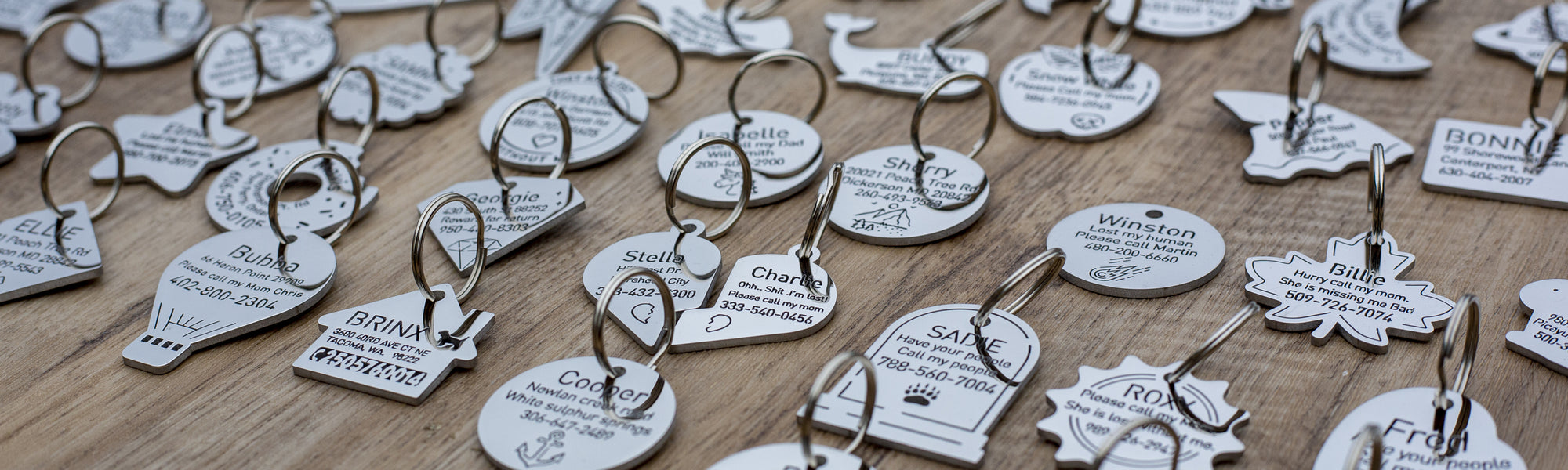
A laser darkens or lightly vaporizes the surface — crisp-looking on day one, but the mark is only microns deep. On anodized aluminum, the laser removes the colored coating; once the surrounding coating scratches and dulls, contrast dies and the text goes ghost-gray. This is the method behind most "engraved" tags sold online, and the reason "engraved" on a listing tells you almost nothing.
Several years Good if truly deep
The characters are pressed or carved into the metal with real depth — think military dog tags. These hold up well, with one catch: as the surface polishes smooth from rubbing, the recessed letters lose contrast against it. Readable up close, harder at arm's length, especially on bright steel in sunlight.
Can't fade The permanent one
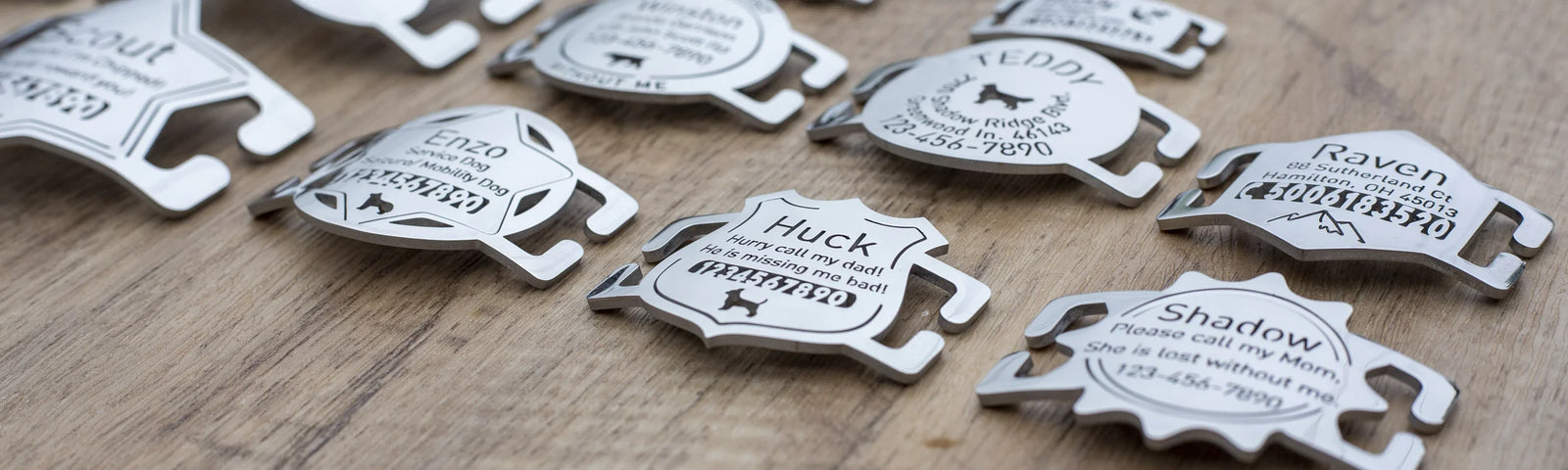
The letters aren't marked on the tag — they're cut through it, so your pet's name and number are stencil-style openings in the metal. There is no ink to strip, no etching to grind down, no contrast to lose. The information isn't on the tag; the information is the tag. For the text to disappear, the tag itself would have to wear away — and that's a decades-long project for solid metal.
| Method | Where the info lives | How it fails | Typical readable life |
|---|---|---|---|
| Printed / painted | On the surface | Ink strips off | Months |
| Surface laser etch | Microns deep | Grinds away, loses contrast | 1–2 years |
| Stamped / deep engraved | Recessed in metal | Contrast fades as surface polishes | Several years |
| Cut through | It IS the metal | Only if the tag itself wears away | Life of the tag |
We don't have to speculate on the last row — our customers have been running the experiment for years:
"This is outstanding dog tag, the information is easy to read and because it is cut all the way through, will not wear off." — James Q., verified Taglec customer
"We have ordered these tags for numerous dogs, in our household, over the years and they never disappoint. The punch technique means the name and phone number never wear off." — Kathryn C.
"Our oldest one is 7 years old and still looks new." — Karen C., customer for years
And our favorite data point: one customer's first set of cut-through tags lasted almost five years of daily wear — and what finally gave out wasn't the lettering. It was the metal around the ring hole. The words outlived the tag's own hardware.
Run a fingernail across the text. If you can't feel the letters, the marking has no depth — it's print or surface etch, and it's on the countdown. Then hold the tag at arm's length in normal light: if you have to tilt it to read the number, a stranger meeting a nervous dog has no chance. An unreadable tag is a blank tag with extra steps.
Our hollow-carved tags are laser-cut all the way through solid metal — that's the fourth row of the table, the one with nothing to wear off. The same construction comes in our silent slide-on tags, which stack the two permanent fixes: lettering that can't fade, on a tag that can't fall off, that also happens to make no noise.
Cut-through lettering needs room — characters can only shrink so far before the openings weaken, so there's a character limit per line (name, phone, a short line — not a paragraph). And because the letters are open, the style is distinctive: modern stencil, not script monogram. If you want six lines of text or cursive fonts, deep engraving is your format; just apply the fingernail test and the depth rule when you shop.
Every Taglec tag is laser-cut to order. Join our newsletter below for 10% off your first tag — the last one you'll need to buy for fading reasons.
Comments will be approved before showing up.
Sign up to get the latest on sales, new releases and more …