
Free shipping worldwide.🌏

0

Your Cart is Empty

Dog Tags

What to Put on Your Dog's ID Tag (And What to Leave Off)

August 07, 2026 5 min read

A dog tag gives you two or three short lines of metal to work with. That's the whole canvas — and what you put on it decides whether a stranger can get your dog home in five minutes or has to hand them to a shelter and hope.

Here's the good news: the decision is simpler than the internet makes it sound. One thing is mandatory, a few things are useful, and several popular choices are actually wasted space. Let's go line by line.

The one thing that must be on the tag: a phone number

Everything else on this page is optional. The phone number is the tag. It's the difference between your dog getting a ride home and getting a ride to animal control.

Make it the right number
  • Your cell, not a landline. When your dog is missing, you're not home — you're out looking.
  • The number you actually answer. Unknown callers included. When your dog is lost, every unknown number is the most important call of your week.
  • Room for one more line? A second number. Partner, parent, neighbor — someone who picks up when you're on a plane. Two numbers roughly doubles the odds of first-call contact.

Does a readable number actually work in the real world? One of our customers found out over a July 4th holiday:

"We got a call at a campground over the Fourth of July holiday asking if we had our dog. We did, but it turned out he had lost his tag in the park. The tag did its job and we met the guy and picked up his tag." — Michele Z., verified Taglec customer

Read that again: the tag wasn't even on the dog anymore, and it still did its job — a stranger picked it up, dialed the number, and closed the loop. That's what one readable phone number buys you.

What to add after the number, in priority order

Line 2: A second phone number

High value As above — backup contact for when you can't answer.

Line 3: "Microchipped"

High value, tiny footprint One word that works three jobs: it tells the finder there's a scannable backup if calls fail, prompts any vet or shelter to scan immediately, and quietly signals that this dog is registered and traceable — which makes them less attractive to keep or sell. (No chip yet? Ask your vet; it's a quick, inexpensive procedure — then the word earns its spot.)

If applicable: "NEEDS MEDS"

Situational, but powerful For dogs with epilepsy, diabetes, severe allergies or similar — nothing motivates a finder to act fast like knowing the clock matters. This line jumps the queue above almost everything when it applies.

Nice-to-have: your city

If room remains "Portland, OR" helps if phone contact fails — it tells the finder or shelter the dog is local, not dumped from elsewhere. It's a fallback for the fallback; add it only if the lines above are covered and the text still reads large.

The great debate: should your dog's name go on the tag?

You'll find warnings online that a name on the tag helps thieves lure your dog away. Here's the honest breakdown:

For the name
  • A finder who can say "Biscuit, come here!" calms a scared dog faster and keeps them from bolting into traffic.
  • It humanizes the dog: "this is Biscuit, someone loves him" reads very differently from an anonymous animal.
  • Most lost dogs are picked up by good Samaritans, not scouted by thieves.
Against the name
  • The luring concern is real in principle — though a dog friendly enough to be lured by name is usually friendly enough to be lured by a treat, no name required.
  • It's the most skippable line when space is tight: the name comforts, but the phone number rescues.

Our take: for most dogs, put the name on — the recovery benefits are concrete and the risk is mostly theoretical. If it makes you uneasy, or your dog is a high-theft-risk breed, skip it without guilt: no finder ever failed to return a dog because the tag lacked a name.

What to leave off (and why)

  • Your full street address. The old-school standard, now outdated: it tells any stranger exactly where your dog — and your empty house — lives, and a phone call is faster than a drive anyway. City alone gives the useful part without the privacy cost.
  • Your own name. The finder doesn't need it to dial. It's a whole line spent on politeness.
  • Email address. Nobody emails about a dog standing in front of them. Too slow, too long, shrinks everything else.
  • Breed, birthday, social handles. Charming, useless in an emergency, and every extra character shrinks the font of the line that matters.
The real reason to cut lines: font size

A tag is a fixed canvas — every line you add shrinks every other line. A two-line tag can wear a phone number readable at arm's length; a six-line tag is a squint test. Prioritize ruthlessly, then let the survivors be big. (This is also why tag size matters — our size guide covers matching tag size to your dog.)

3 ready-to-use layouts (copy these)

Layout Lines Best for
Minimalist BISCUIT
555-0142
Small tags, small dogs — maximum font size
Standard BISCUIT
555-0142 / 555-0143
MICROCHIPPED
Most dogs — the best all-round setup
Medical BISCUIT · NEEDS MEDS
555-0142 / 555-0143
MICROCHIPPED
Dogs whose finder needs to hurry

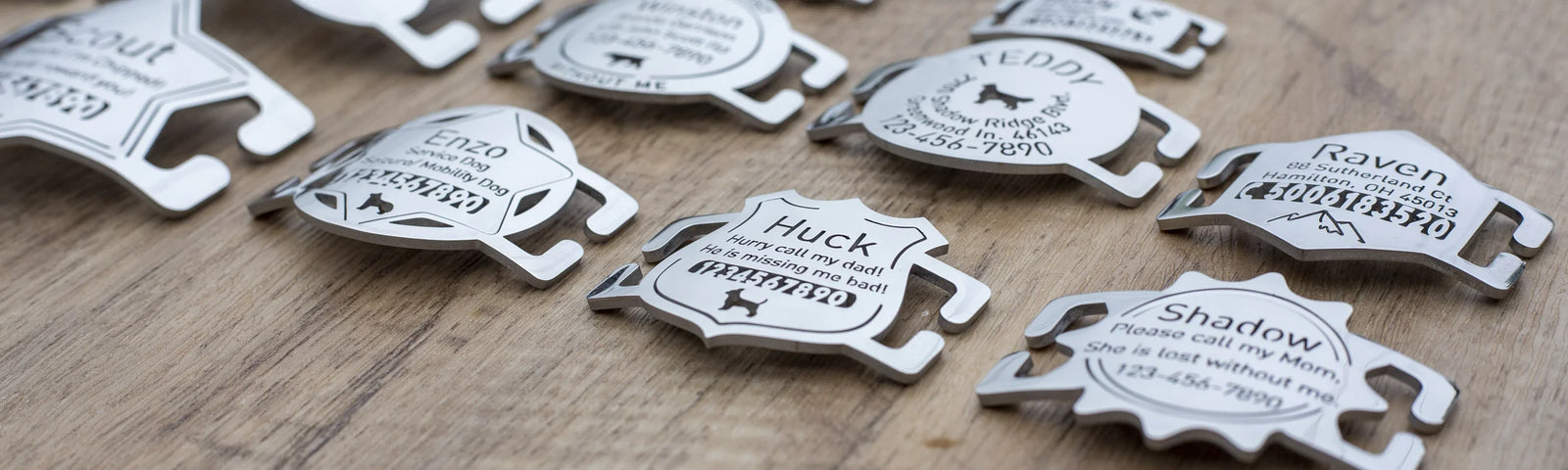
Whichever layout you choose, it only works as long as it's readable — which is a durability question as much as a design one. A number that wears off in a year resets you to an anonymous dog. On our hollow-carved tags, the lettering is laser-cut through the metal, so the layout you pick today is the layout a stranger reads five years from now. Prefer nothing dangling at all? The same cut-through lettering comes on our silent slide-on tags.

One of our long-time customers — six dogs' worth of tags — put the whole philosophy in one line:

"The information on them is invaluable if a dog gets lost." — Michael Barry, verified Taglec customer

Design Your Dog's Tag →

Every Taglec tag is laser-cut to order. Join our newsletter below for 10% off — and get the layout right the first time.

Frequently asked questions

Should I put my dog's name on the ID tag?
For most dogs, yes — a finder who can use the name calms a scared dog faster, and most lost dogs are recovered by good Samaritans. The "name helps thieves lure dogs" concern is mostly theoretical; if it worries you or your dog is a theft-target breed, skip the name — the phone number is what actually gets dogs home.
Should I put my address on my dog's tag?
Skip the full street address: it costs privacy and space, and a phone call beats a drive anyway. If you have room after phone numbers and "microchipped," your city alone gives the useful signal (the dog is local) without telling strangers where you live.
How many phone numbers should go on a dog tag?
Two, if the tag allows it: your cell plus a backup person who answers when you can't. One readable number beats two cramped ones, though — if adding the second shrinks the text badly, keep one number big.
What do I do when my phone number changes?
Order the replacement tag immediately, and bridge the gap the same day: write the new number inside the collar with a permanent marker, and update your microchip registration — the chip record matters even more than the tag when your number changes.

↑ Back to top

Leave a comment

Comments will be approved before showing up.