
Free shipping worldwide.🌏

0

Your Cart is Empty

Dog Tags

How to Stop Your Dog's Tags from Jingling: 6 Fixes Ranked

July 21, 2026 7 min read

It's 3 AM. Your dog shakes, scratches an ear, or just repositions on the bed — and the house fills with that familiar metallic clink-clink-clink. If you've ever considered taking the tags off entirely just to get some sleep, you're not alone. It's one of the most common complaints dog owners have.

But going tagless isn't the answer. According to the American Kennel Club, a visible ID tag is still the fastest way for a stranger to get your lost dog home — no scanner, no vet visit, just a phone call. So the real question is: how do you keep the tags on and the noise off?

Here are six fixes, ranked from temporary patches to the permanent solution.

First, why do dog tags jingle?

The noise comes from metal hitting metal. Three collisions, specifically:

  1. Tag against tag. Most dogs wear two or three: the ID tag, the rabies tag, the city license. Every step knocks them together.
  2. Tag against collar hardware. A single dangling tag still swings into the D-ring and buckle.
  3. Tag against everything else. Food bowls, crate bars, hardwood floors.
The root cause in one word: dangling

Any tag that hangs and swings freely will make noise. It's also why the jingling gets worse over time — constant metal-on-metal contact grinds the engraving off, and owners respond by adding a new (louder, shinier) replacement tag to the stack.

One of our customers, Christine — who owns a Dutch Shepherd and a Malinois, two breeds that never stop moving — put it this way:

"I was so sick of tags that rubbed against each other and wore the printing off within a few months. Finally a tag I can put on, with the rabies tag, with the city tag, with the microchip tag. And it won't just wear flat in a few months." — Christine P., verified Taglec customer

Keep that in mind as we go through the fixes: the jingling and the fading are the same problem wearing two hats.

Fix 1: Rubber tag silencers

$3–8 Partial fix Lasts months

What it is: A rubber or silicone ring that wraps around the edge of each tag, so tags bump rubber instead of metal.

Does it work? Partially. It muffles tag-on-tag contact but does nothing about the tag swinging into the collar hardware. And because silencers are sized to standard shapes (round, bone), they don't fit custom or decorative tags. They also crack and fall off after a few months of outdoor wear — most owners don't notice until the noise comes back.

Best for: A cheap stopgap while you decide on something permanent.

Fix 2: The DIY route — tape, moleskin, or a hair tie

~$0 Partial fix Lasts days

What it is: Wrapping the tag stack in electrical tape, sticking moleskin between tags, or binding them together with a small elastic.

Does it work? For about a week. Tape peels in the rain, elastics snap, and all of these methods share one real downside: they cover the very information the tag exists to display. A good Samaritan who finds your dog shouldn't have to peel tape off a wet collar to find your phone number.

Best for: An emergency quiet night before guests arrive. Not a real solution.

Fix 3: Tag pouches

$8–15 Silences fully Hides your info

What it is: A small neoprene or fabric pouch that zips or wraps around the whole tag bundle and attaches to the collar.

Does it work? Yes — for the noise. Pouches are genuinely quiet. But they hide your contact info completely, which defeats the purpose of an ID tag. Anyone who finds your dog sees a mystery pouch, not a phone number. Pouches also absorb water and smell after a few swims.

Best for: Dogs that are microchipped and never off-leash — but see the microchip section below before relying on that.

Fix 4: Consolidate your tags

$0 Halves the noise Do this regardless

What it is: Cutting the stack from three tags to one. In many areas you can keep the rabies certificate on file instead of on the collar (check your local ordinance), and a single well-made ID tag can carry your pet's name, your phone number, and a "microchipped" line — replacing two of the three jinglers.

Does it work? It halves the noise, because tag-on-tag contact is the loudest of the three collisions. It won't eliminate it — one dangling tag still swings into the collar hardware.

Best for: Everyone. Do this regardless of which other fix you choose.

Fix 5: An embroidered collar

$15–30 Silent One line of text only

What it is: A collar with your phone number stitched directly into the webbing. No tags, no noise.

Does it work? For silence, completely. The trade-offs: embroidery is limited to one line of blocky text, it fades and frays with the collar (typically 1–2 years outdoors), and if you switch collars — bath time, a new harness, a spare — the ID stays behind on the old one. Most owners end up adding a tag back anyway for the details a collar can't hold.

Best for: A backup layer of ID, not a replacement.

Fix 6: Switch to a slide-on tag (the permanent fix)

$15–25 Completely silent Lasts years

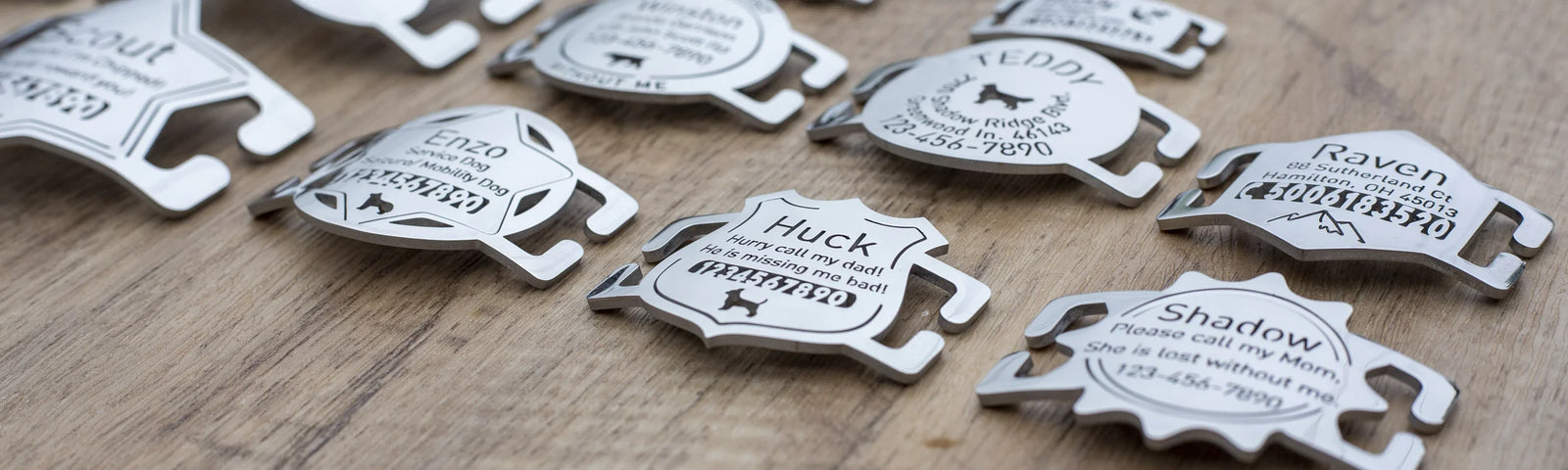
What it is: Instead of dangling from a ring, a slide-on dog tag threads onto the collar itself and lies flat against the webbing. Nothing hangs, nothing swings, nothing clinks.

Does it work? Completely, and permanently. Remember the root cause — dangling. A slide-on removes the dangle itself, which means:

Why removing the dangle fixes everything at once
  • Zero noise. No swing, no collision, no 3 AM clink. This is why slide-ons are also called silent dog tags.
  • No split ring to fail. On a dangling tag, the weakest point isn't the tag — it's the ring. A dangling tag snags on brush, deck boards, and other dogs' teeth until the ring gives. A slide-on has no ring to give.
  • The engraving can't rub off. Nothing swings, so nothing grinds. And on our tags the text isn't printed or surface-etched — it's laser-cut through the metal.

That split-ring point is the part nobody warns you about. We read every review we get, and the pattern is unmistakable:

"He straightened out the split ring while playing in the bushes." — David K., after his dog Murdock lost a tag
"By the time I got home he was free but the ring was straight and the tag was off." — Laura J.

And on the cut-through engraving:

"The information is easy to read and because it is cut all the way through, will not wear off." — James Q.
The trade-offs, honestly

A slide-on needs to match your collar width (measure before ordering — most fit standard 3/4" to 1" flat collars), and it doesn't transfer between collars as quickly as clipping a ring. That's the whole list.

Best for: Anyone who wants to solve the noise once instead of managing it forever.

Quick comparison

Fix Silences it? Info stays visible? Lasts? Cost
Rubber silencer Partly Yes Months $3–8
Tape / DIY Partly No Days ~$0
Tag pouch Yes No A year $8–15
Consolidating tags Halves it Yes $0
Embroidered collar Yes One line only 1–2 yrs $15–30
Slide-on tag Yes Yes Years $15–25

"Can't I just skip tags? My dog is microchipped."

Chip + tag, not chip vs. tag

A microchip is essential — but it's a backup, not a replacement. A chip only works if whoever finds your dog takes them to a vet or shelter with a scanner, during business hours, and your registration is current. The American Veterinary Medical Association recommends chips in addition to visible ID for exactly this reason: a tag gets your dog home in one phone call; a chip gets them home in one car trip that a stranger may or may not make. Wear both. Just wear them quietly.

The bottom line

Silencers, tape, and pouches all try to manage the symptom — a dangling piece of metal — with varying success and real downsides. Consolidating your tags helps no matter what. But if you want the jingling gone for good, remove the dangle: a slide-on tag sits flat, stays silent, can't lose its ring, and keeps your number readable for years.

Our customers say it better than we can:

"Her Taglec name tag is sturdy, attractive, and won't become unreadable. Smart tag for a smart dog." — Lynn E., whose dog is "hard on tags"

Shop Silent Slide-On Dog Tags →

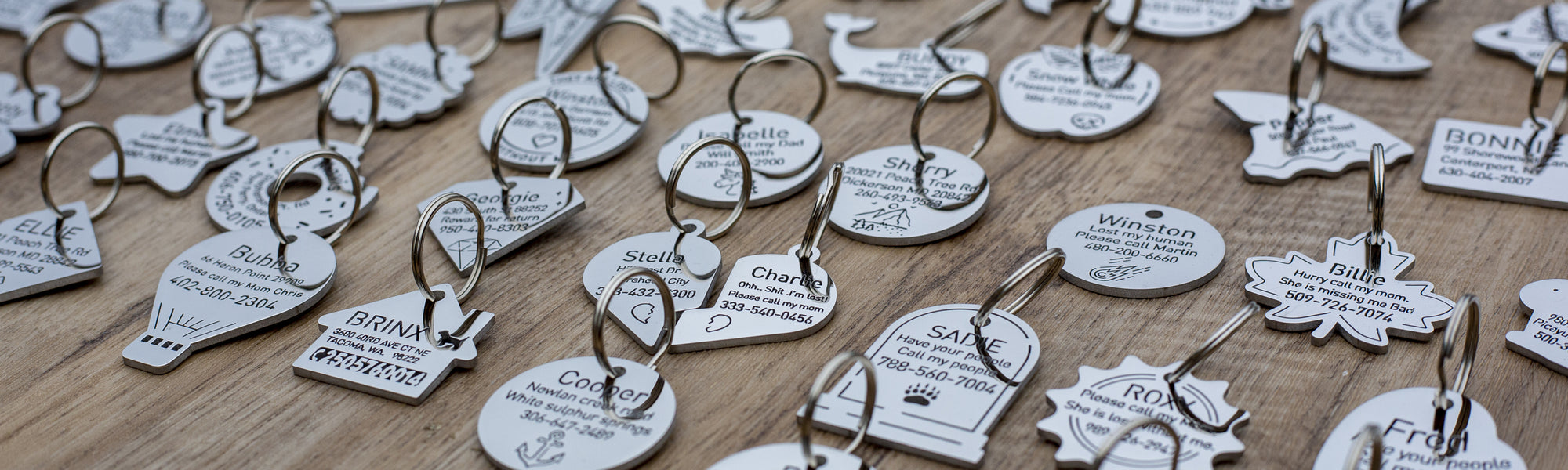
Prefer the classic hanging style? Our hollow-carved tags use the same cut-through engraving that never fades — and a thicker gauge ring than the standard hardware-store split ring.

Every Taglec tag is laser-cut to order. Join our newsletter below for 10% off your first tag — and the occasional dog photo we can't keep to ourselves.

Frequently asked questions

Why does my dog's tag jingle so much?
The noise is metal-on-metal contact: tags hitting each other, and the tag stack swinging into the collar's D-ring and buckle. Any tag that dangles will jingle; the more tags on the ring, the louder it gets.
Do rubber tag silencers actually work?
They reduce tag-on-tag noise but don't stop the tag from hitting the collar hardware, and they typically crack and fall off within a few months outdoors. They're a stopgap, not a fix.
What is a silent dog tag?
A silent dog tag (also called a slide-on or slide-along tag) threads onto the collar and lies flat against it instead of hanging from a ring. With nothing dangling, there's nothing to swing, collide, or jingle — and no split ring to fail.
Is it safe for my dog to wear no tags if he's microchipped?
Vets recommend both. A chip requires a scanner and a trip to a vet or shelter; a visible tag lets anyone who finds your dog call you immediately. The tag is the fast path home — the chip is the backup.

↑ Back to top

Leave a comment

Comments will be approved before showing up.