
Free shipping worldwide.🌏
Your Cart is Empty
Every shape, laser-cut and custom engraved.
Attachment styles that stay put and stay quiet.
Every shape, laser-cut and custom engraved.
July 21, 2026 6 min read
You reach down to clip the leash and something's off. The collar's there. The rabies tag's there. But the ID tag — the one with your phone number on it — is gone. Somewhere in the yard, the park, or a mile of trail, there's a small metal disc with your number on it, and your dog is now anonymous.
If this has happened to you more than once, it's not bad luck. Tags fall off for one predictable, mechanical reason — and once you see it, you can fix it permanently. Let's start with right now, then fix forever.
Safety net in place? Good. Now let's make sure you never need it.
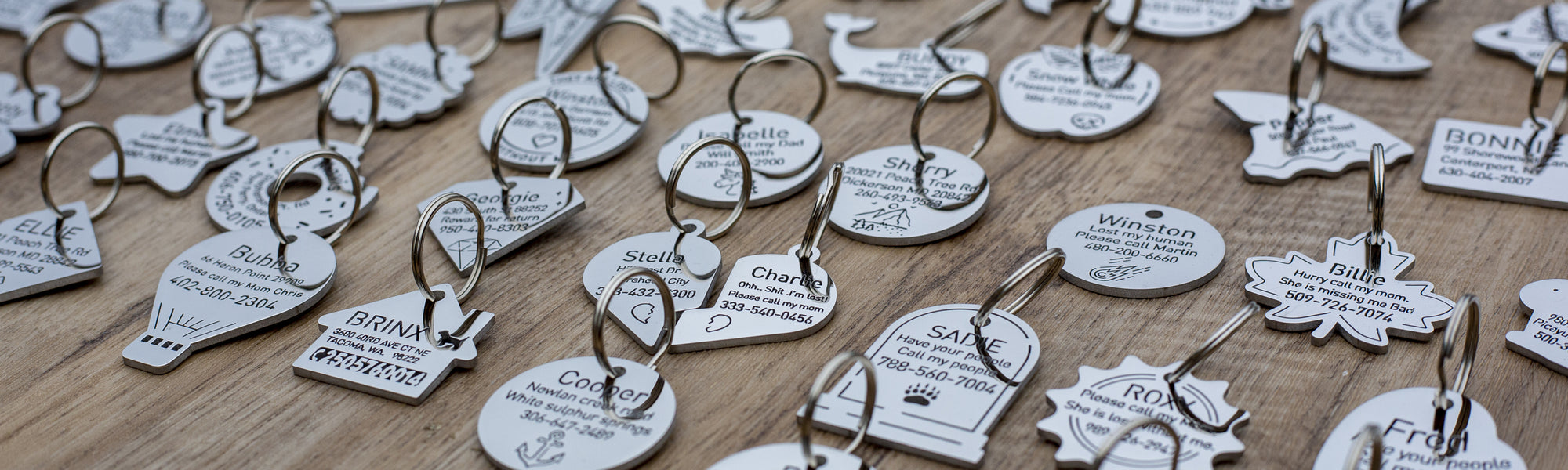
Here's the thing almost nobody considers when buying a tag: the tag and the attachment are two different products — and the failure point is almost never the tag. It's that little coiled ring, the same hardware as your keychain.
A split ring holds by spring tension alone. Nothing is locked or welded — the ring stays closed only as long as the metal keeps its coil shape. Which means anything that pries the coil apart, even slightly, starts a one-way process: each snag opens it a little more, until one day the tag slides right off the end.
We read every review that comes in, and the split-ring stories all sound the same:
"He straightened out the split ring while playing in the bushes." — David K., after his dog Murdock lost a tag
"By the time I got home he was free but the ring was straight and the tag was off." — Laura J.
The ring was straight. That phrase comes up again and again — because that's exactly how spring tension dies. And notice something: the dogs were fine, the collars were fine, even the tags were fine, wherever they ended up. Only the ring failed.
Most common A dangling tag swings freely, which makes it a hook. Bushes, wire fences, deck-board gaps, another dog's jaw during play — anything that catches the tag and pulls levers the split ring open. One of our customers watched his dog's tags get pulled off in the gaps of his dock decking, repeatedly, until he switched formats.
Slow and invisible Even with no dramatic snag, a swinging tag works the ring thousands of times a day — every step is a tiny flex. Thin, soft rings (the kind bundled free with cheap tags) lose their spring within months. The tag doesn't fall off during the adventure; it falls off on an ordinary Tuesday, and you never see where.
Worst offender Some tags ship with an S-shaped hook that you squeeze shut with pliers. If it's not crimped fully closed — and it almost never is — it's just an open question mark holding your dog's identity. S-hooks also gouge the collar's D-ring as they swing. If your tag hangs on an S-hook, replace it today with any closed ring.
Cheap tags only Thin stamped aluminum tags can fail at the tag itself: the ring hole slowly saws outward until the edge breaks. This one's rare with any decent-gauge tag — our tags are laser-cut from thick stock, so the hole outlives the dog's wardrobe of collars — but check for it if your tag is the free kind from a vending machine.
$0 Detection, not prevention
Grab the ring and try to slide a thumbnail between the coils. If the gap takes your nail easily, or the ring's end sticks out from the coil, the spring is dying — replace it before the walk, not after. This catches fatigue, but it can't stop a snag.
$2–5 Big upgrade
Not all split rings are equal. A heavy-gauge stainless ring resists prying an order of magnitude better than the soft, thin ring bundled with most tags. Our hollow-carved tags ship with a thicker-gauge ring than standard hardware-store hardware for exactly this reason. If you love the hanging style, this plus the monthly thumbnail test is the way to keep it.
$5–10 Snag-proof-ish Adds bulk
Small screw-lock carabiners or bolt-snap clips can't be pried open by a snag. The trade-offs: they add a link of length and weight to the dangle (a real issue on small dogs — see our size guide), they can vibrate loose if the screw sleeve isn't tightened, and they make the jingling worse, not better.
$32–34 Nothing to fail
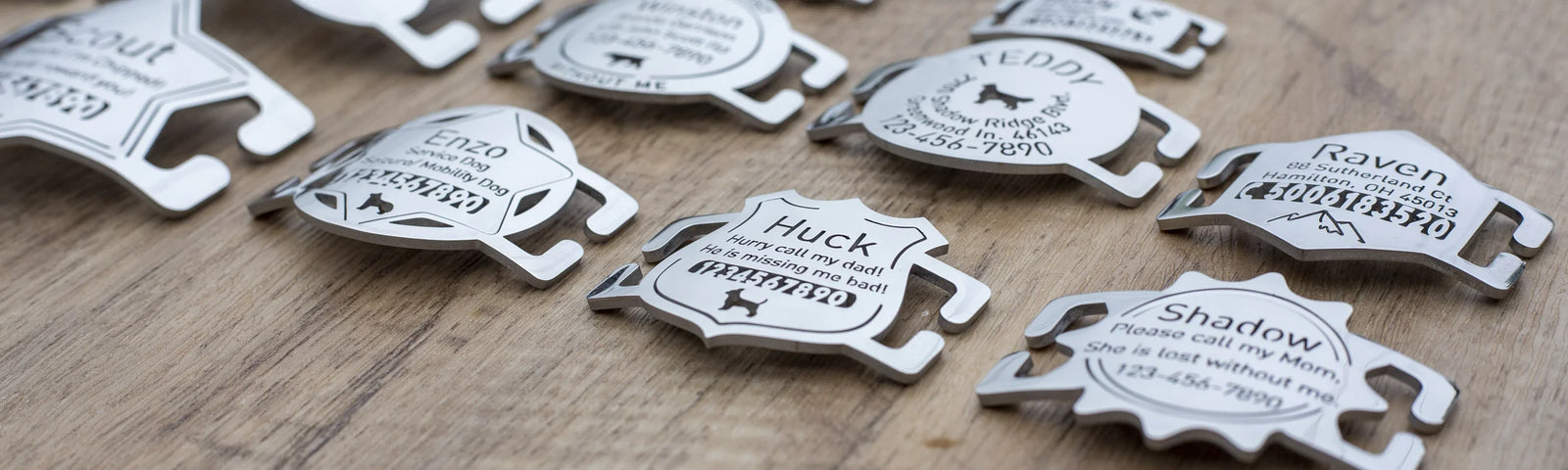
Every fix above hardens the weak link. A slide-on tag deletes it: the tag threads onto the collar itself and lies flat against the webbing. No ring, no clip, no hook — the tag can't fall off the collar any more than a belt loop can fall off a belt.
A slide-on must match your collar's width (measure the strap — most fit 3/4" to 1" flat collars), and it fits flat collars only, not rolled leather or chain. Moving it to another collar takes a few seconds longer than clipping a ring.
| Attachment | Snag-proof? | Fatigue-proof? | Watch out for |
|---|---|---|---|
| S-hook | No | No | Replace it today |
| Standard split ring | No | No | Monthly thumbnail test |
| Heavy-gauge split ring | Resists | Yes, for years | Still a dangle that can catch |
| Locking clip | Yes | Yes | Adds length, weight, noise |
| Slide-on tag | Yes — nothing to catch | Yes — nothing to flex | Flat collars only; match the width |
A lost tag isn't bad luck — it's spring tension losing an argument with a bush. You can manage the split ring (test it monthly, upgrade the gauge), armor it (locking clip), or retire it entirely with a slide-on that has nothing to fail. Whichever you choose, do the 10-minute safety net above today: current chip registration, number on the collar. Your dog's ride home should never depend on a single coil of wire.
Shop Slide-On Tags — Nothing to Fall Off →
Every Taglec tag is laser-cut to order. Join our newsletter below for 10% off your first tag — and one less thing that can fall off in the bushes.
Comments will be approved before showing up.
Sign up to get the latest on sales, new releases and more …