
Free shipping worldwide.🌏

0

Your Cart is Empty

Dog Tags

Dog Tag Size Guide: What Size Does Your Dog Actually Need?

July 21, 2026 6 min read

Here's an uncomfortable fact we learned from reading our own reviews: when a customer is unhappy with a tag, the most common reason isn't the engraving, the design, or the shipping. It's the size. "It was much bigger than we expected." "I wished I had ordered a smaller size." "Heavy metal for small dogs."

Sizing a dog tag sounds trivial — until you're holding a tag that looked medium on a screen and looks like a dinner plate on your Chihuahua. So this is the guide we wish every customer read before ordering: how tag sizing actually works, what goes wrong at each end of the scale, and how to get it right the first time.

The three things tag size actually affects

  1. Comfort and weight. A tag that's fine on a Labrador is a wearable dumbbell on a 6-pound Yorkie. Small dogs and cats notice every gram hanging off their neck.
  2. Hang length. It's not just the tag — it's the tag plus the ring. An oversized jump ring can make even a small tag dangle low enough to clip a water bowl or drag on the floor when your dog lies down.
  3. Readability. This is the reason not to go too small. Your phone number is the whole point of the tag. Shrink the tag and you shrink the text — and a stranger squinting at a wiggling, nervous dog needs to read that number in one glance.
"The jump rings that came with the tags were entirely too large, and using them made the tags hang way too low on our small dogs." — Pamela W., verified Taglec customer
The balance point

The right size is big enough to read instantly, small enough that your dog forgets it's there.

Dog tag size chart by weight

Your pet Weight Recommended tag size Examples
Cats & toy breeds Under 12 lb Small — approx. 7/8" / 22 mm Cats, Chihuahua, Yorkie, toy Poodle
Small dogs 12–25 lb Small — approx. 1" / 25 mm Shih Tzu, Frenchie, Beagle
Medium dogs 25–55 lb Large — approx. 1.25" / 32 mm Border Collie, Aussie, Staffy
Large dogs 55 lb and up Large — approx. 1.5" / 38 mm Lab, Shepherd, Husky, Golden
On the fence between two sizes?

Go smaller for hanging tags — and here's why: on a screen, every tag photo is zoomed in, so almost everyone overestimates. In years of reviews, "it was bigger than I expected" outnumbers "too small" by a wide margin. The one consistent exception is heavy-coated large breeds — a tag can disappear into a Husky's ruff, so size up if there's fur to compete with.

Small dogs and cats: the two traps

Trap 1: weight

Thick metal is a feature on a big dog and a burden on a small one. If your pet is under ~12 pounds, treat weight as your first filter, not an afterthought. A lightweight tag your cat tolerates is worth infinitely more than a premium slab she scratches at until the collar comes off.

"It was much bigger than I expected it to be… I had to remove it from her collar." — a cat owner, in our reviews. Lesson learned — that's why this guide exists.
Trap 2: total hang length

Tag height + jump ring can double the dangle on a short-legged dog. If your dog is low to the ground, a smaller ring matters as much as a smaller tag — the tag should sit at the chest, not swing at the elbows.

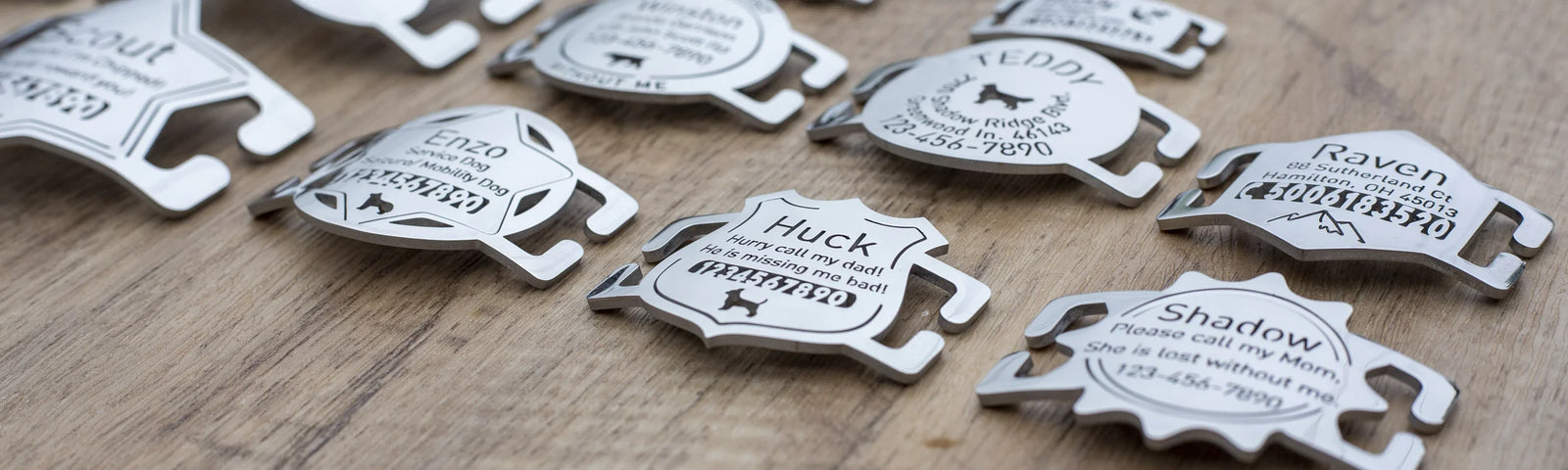
Or skip the dangle entirely: a slide-on tag lies flat against the collar, so hang length becomes zero and the weight rests on the collar instead of pulling on it. For tiny pets it's the most comfortable format there is — and as a bonus, it's completely silent.

Big, rough-and-tumble dogs: think snag, not just size

Big-dog sizing has the opposite problem. The tag itself is rarely too heavy — but a dangling tag on a dog that plays hard becomes a hook. It catches on brush, fences, other dogs' teeth. One of our customers, Byron, discovered a failure mode we'd never have predicted: his dog's hanging tags kept slipping into the gaps of his dock decking and getting pulled off. His fix, in his own words:

"We switched to the collar slip tag and no problems. Nice weight and size for our 60#." — Byron T., verified Taglec customer

So for large active dogs, the choice is: a properly sized hanging tag with a heavy-gauge ring — our hollow-carved tags in the large size are cut from thick stock precisely for these dogs — or a slide-on that has nothing to snag at all.

Slide-on tags: measure the collar, not the dog

The one rule that's different

A slide-on is sized to your collar's width, not your dog's weight.

  1. Take the collar off and lay it flat.
  2. Measure the width of the webbing (the strap itself, not the length). Most collars are 3/4" (20 mm) or 1" (25 mm).
  3. Match that width to the tag's stated collar-width range. The tag should slide on snugly — a tag sized for a 1" collar will rotate and slide around on a 5/8" strap.
  4. One caveat: slide-ons fit flat collars. Rolled leather, chain, and martingale-style collars need a hanging tag instead.

What if I still get it wrong?

Then we'll fix it

One customer ordered a tag that turned out too big for her Yorkie — she wrote to us, and we sent a smaller replacement at no charge. That's not a one-off; if the size doesn't work on your pet, contact us and we'll make it right. A tag that fits is the only kind worth making.

The 30-second version

TL;DR
  • Hanging tags: size by weight (chart above). When in doubt, go smaller — unless your dog has a thick coat.
  • Under 12 lb: weight and hang length are everything. Small tag, small ring — or a slide-on with zero dangle.
  • Big rough players: large tag with a heavy ring, or a slide-on with nothing to snag.
  • Slide-ons: measure your collar width, not your dog. Flat collars only.
  • Readability is the floor: if the size can't fit a legible phone number, it's too small, full stop.

Find Your Dog's Tag →

Every Taglec tag is laser-cut to order. Join our newsletter below for 10% off your first tag — and sizing help is one reply away.

Frequently asked questions

What size tag should I get for a puppy?
Size for the adult dog, not the puppy — with one exception. If your breed's adult weight is far off (a Great Dane puppy at 15 lb), a full-size tag now is overkill; start with a small tag and upgrade at adulthood. For breeds that stay under 25 lb, just buy the small size once. Either way, a puppy should never go tagless while "growing into" one.
Are heavy tags bad for small dogs?
A tag that's disproportionately heavy for a small dog or cat causes constant neck-load and scratching, and often ends with the pet pawing the collar off — which means no ID at all. Under ~12 lb, choose the smallest, lightest tag that still fits a readable phone number, or a slide-on that transfers the weight to the collar itself.
What size dog tag fits a cat?
Use the smallest size available and check the total hang: on a cat's short neck, tag plus ring shouldn't reach past the chest. A slide-on sized to the collar width is often the better format for cats — nothing dangles for them to bat at. Make sure it's on a proper breakaway cat collar.
How do I measure my dog's collar for a slide-on tag?
Lay the collar flat and measure the width of the strap itself — not the length around the neck. Most flat collars are 3/4" (20 mm) or 1" (25 mm). Match that number to the tag's stated collar width; it should slide on snug, without room to spin.

↑ Back to top

Leave a comment

Comments will be approved before showing up.